AI Pronunciation Training: How Real-Time Speech Feedback Is Helping Language Learners Sound Like Natives in 2026
You've been studying for months. Grammar clicks. Vocabulary sticks. Then you open your mouth in a real conversation — and the person across from you squints, tilts their head, and asks you to repeat yourself.
That moment is where most language learners quietly give up on sounding natural.
Here's what's at stake: pronunciation errors don't just cause awkward pauses. A 2024 study from the University of Barcelona found that listeners judge speakers with strong non-native accents as less credible and less competent — even when the content is identical. Your accent is shaping how people perceive your intelligence before you finish your sentence.
But 2026 has changed the game. AI pronunciation training has moved from novelty to necessity, and the research backing it is no longer speculative. It's measurable. It's dramatic. And it's available to anyone with a phone.
Let's break down exactly how it works — and how you can use it starting today.
How AI Speech Recognition Actually Scores Your Pronunciation
Forget the old binary: "correct" or "incorrect." That model died around 2023.
Modern speech recognition language learning systems operate on three distinct layers. Each one targets a different dimension of how you sound.
Phoneme-Level Scoring
A phoneme is the smallest unit of sound in a language. English has roughly 44. Mandarin has about 56 (depending on how you count tonal variants). Spanish sits around 24.
When you speak into an AI pronunciation practice tool in 2026, the system doesn't hear "words." It hears a sequence of phonemes — and it scores each one individually against a native-speaker reference model trained on tens of thousands of hours of speech data.
Miss the aspiration on an English /p/? The system catches it. Confuse the French /y/ with /u/? Flagged instantly.
This granularity matters. Research published in Language Learning & Technology (January 2026) showed that learners who received phoneme-level AI feedback improved their phonetic accuracy by 15 points on standardized pronunciation assessments over 12 weeks — compared to just 4 points for learners using traditional audio-repetition methods.
Fifteen points. Same study duration. Same motivation level. The difference was the feedback loop.
Prosody Analysis
Phonemes are the atoms. Prosody is the music.
Prosody covers stress patterns, rhythm, and the timing between syllables. It's why "I didn't steal your MONEY" means something completely different from "I didn't STEAL your money."
AI systems in 2026 analyze prosody by mapping your speech waveform against expected stress-timing patterns. They detect whether you're placing emphasis on the right syllable, whether your sentence rhythm matches the target language's natural cadence, and whether your pacing sounds robotic or fluid.
This is where accent reduction AI has made its biggest leap. Most "foreign accent" perception comes not from individual mispronounced sounds, but from misplaced stress and unnatural rhythm.
Intonation Mapping
Intonation is pitch movement across a phrase. It signals questions, statements, sarcasm, surprise.
Get it wrong, and you sound flat. Or confused. Or rude — without knowing why.
Current AI models extract your pitch contour in real time and overlay it against native-speaker norms. The visual feedback is immediate: you see your pitch curve, you see the target curve, and you see exactly where they diverge.

At LingoTalk, we've integrated all three layers — phoneme scoring, prosody analysis, and intonation mapping — into a unified feedback experience. The goal isn't just to tell you something's wrong. It's to show you precisely what is wrong and where in your mouth to fix it.
Why Traditional Methods Fall Short
Let's be honest about what came before.
Listening and repeating. Mimicking podcasts. Watching a teacher's mouth. These methods aren't useless — but they share a fatal flaw.
They give you no objective measurement.
You say a word. You think it sounded right. Maybe it did. Maybe it didn't. You have no way to know unless a trained phonetician is sitting next to you — and even then, human ears are inconsistent. A 2025 meta-analysis in Applied Linguistics found that native-speaker pronunciation ratings varied by up to 22% across evaluators for the same audio sample.
AI doesn't have that variance. It scores the same utterance the same way, every time. That consistency is what makes deliberate practice possible.
Without consistent feedback, you can't isolate your weak points. Without isolating your weak points, you practice everything equally — which means you improve at nothing efficiently.
The 20-Minute Daily Drill Protocol
Research is encouraging, but only if you act on it. Here's a practical daily protocol designed around AI feedback loops. It's built on the same principles used in the 2026 Language Learning & Technology study.
Twenty minutes. Every day. No exceptions.
Minutes 1–5: Diagnostic Warm-Up
Read a short passage (60–90 words) into your pronunciation feedback app.
Don't try to be perfect. Just speak naturally.
The AI will generate a phoneme-level report. Look at the bottom 3–5 sounds — these are your targets for the session. Every session starts fresh because your weak spots shift as you improve.
Minutes 5–12: Isolated Phoneme Drilling
Take your weakest scored phoneme. Practice it in isolation first: just the sound, repeated five times with AI scoring after each attempt.
Then practice it in minimal pairs — word pairs that differ by only that one sound. Think "ship" vs. "sheep," "bat" vs. "bet."
This is where improvement actually happens. The AI tells you after each repetition whether your score went up, down, or stayed flat. You're not guessing. You're calibrating.
Spend about 90 seconds per phoneme. Cover your 3–5 weakest sounds.
Minutes 12–17: Prosody and Intonation Pass
Return to the same passage from your warm-up. This time, focus on rhythm and pitch.
The AI will highlight stress errors and intonation drift. Exaggerate the corrections — research on motor learning consistently shows that overcorrection accelerates the path to natural production.
If the system shows your pitch is too flat on questions, make your pitch rise feel almost cartoonish. Your brain will find the middle ground faster than if you aim for subtle.
Minutes 17–20: Free Speech Integration
Speak freely for three minutes on any topic. Describe your day. Summarize an article. Argue with an imaginary friend.
The point is to transfer your drilled improvements into spontaneous speech. The AI scores this too — and this is where you see whether isolated practice is translating into real fluency.
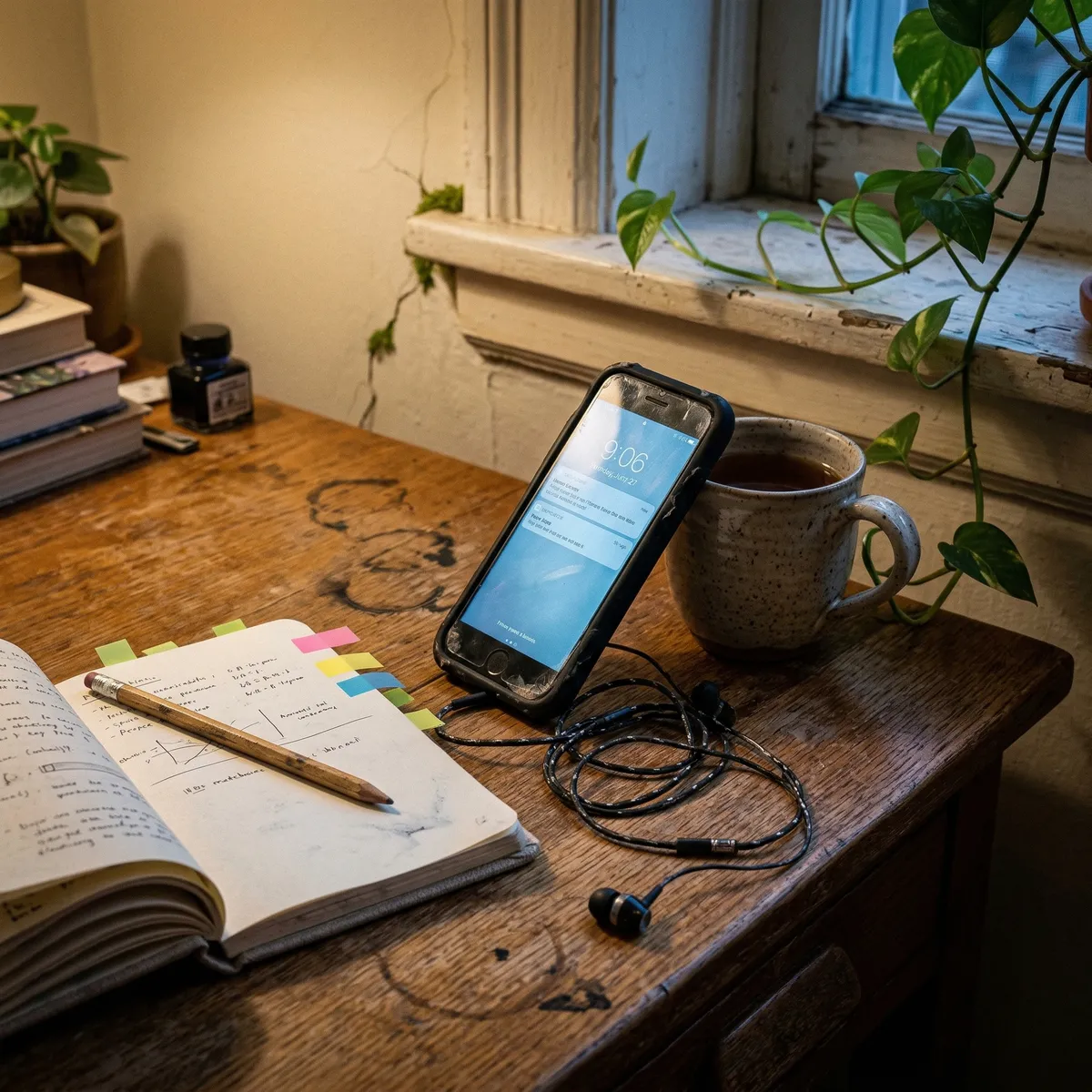
Track your scores daily. The compound effect is staggering. The 2026 study participants who followed a similar structured protocol showed measurable gains within the first two weeks — and the improvement curve didn't plateau until week ten.
What the Numbers Actually Show
Let's zoom into that 15-point gain because numbers without context are just decoration.
The study used a 100-point phonetic accuracy scale based on the Speech Accent Archive methodology. The control group — using traditional listen-and-repeat methods — moved from an average of 61 to 65 over 12 weeks.
The AI feedback group moved from 60 to 75.
That 75-point threshold matters. Previous perceptual research has established that scores above 72 on this scale correlate with listeners rating speakers as "easily intelligible with mild accent" — the practical threshold where accent stops being a communication barrier.
In other words, AI pronunciation training didn't just improve scores. It moved learners across a perceptual boundary that changes how the world responds to them.
Common Mistakes Learners Make With AI Pronunciation Tools
The technology works. But learners still sabotage themselves. Here's how.
Practicing only what feels comfortable. If you keep drilling sounds you already score 90+ on, you're performing, not practicing. Chase the red scores. That's where growth lives.
Ignoring prosody. Most learners obsess over individual sounds and skip the rhythm work entirely. But prosody accounts for roughly 60% of perceived accent strength, according to a 2023 University of Edinburgh analysis. The music matters more than the notes.
Skipping free speech. Isolated drilling is necessary but insufficient. If you can nail a phoneme in a minimal pair but lose it mid-sentence, you haven't acquired it yet. The integration phase is non-negotiable.
Going too long without breaks. Twenty minutes of focused pronunciation practice is more effective than sixty minutes of tired repetition. Vocal fatigue degrades your production quality, and the AI will faithfully score your fatigue-induced errors — teaching your brain the wrong patterns.
Where This Is Heading
The trajectory is clear. By late 2026, the best AI systems will incorporate articulatory feedback — showing you not just what to fix, but how your tongue, lips, and jaw should move to produce the target sound, using real-time 3D mouth models personalized to your specific error patterns.
We're building toward that future at LingoTalk. The current speech feedback tools already give learners more precise, more patient, and more consistent coaching than most human tutors can provide at scale.
That's not a knock on human teachers. It's an acknowledgment that pronunciation is a motor skill — and motor skills improve fastest with immediate, objective, and repeatable feedback. That's what AI does best.
The Takeaway You Can Act On Today
Your pronunciation is not a fixed trait. It's a trainable skill with a measurable improvement curve.
The evidence is in. A structured 20-minute daily practice with real-time AI feedback produces results that traditional methods simply cannot match. Fifteen points in twelve weeks. The difference between being asked to repeat yourself — and being understood the first time.
Start with your weakest sounds. Drill them with precision. Let the AI show you what your ears can't hear yet.
The gap between where you are and sounding like a native speaker is smaller than you think. The tools to close it are already in your pocket.
Ready to speak a new language with confidence?