
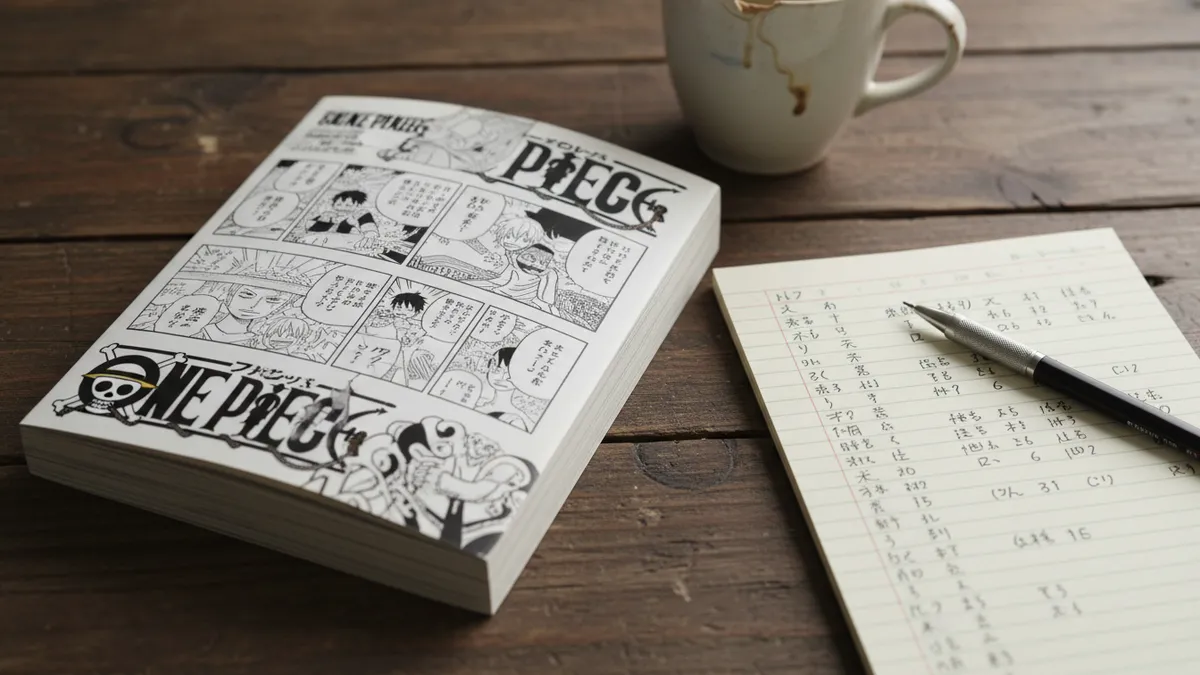
How AI Is Turning Anime and Manga Into the Ultimate Japanese Learning System — The Complete Otaku-to-Fluency Pipeline for 2026
You've been here before — sitting cross-legged, three episodes deep into a new season, catching fragments of Japanese between subtitle flashes. You feel something building. You recognize いただきます before the translation appears, you know what なるほど means without thinking, and somewhere in the back of your mind there's a voice whispering: I could actually learn this language. And then you open a textbook, and everything you absorbed — all that living, breathing Japanese — evaporates into rows of decontextualized grammar tables.
That gap between passive absorption and actual fluency? AI has finally built a bridge across it. Not a flimsy, theoretical bridge either — a full-scale infrastructure of tools that transforms the anime and manga you already consume into a structured Japanese learning system. Let's walk the whole pipeline, from your Crunchyroll queue to genuine conversational fluency.
Why Does Anime Feel Like It Should Teach You Japanese — But Doesn't Quite?
The intuition isn't wrong. Anime provides something textbooks structurally cannot: emotional context. When Tanjiro screams 守る (mamoru — to protect) in a moment of desperate resolve, your brain encodes that word differently than it would from a vocabulary list. Neurolinguistic research consistently shows that emotionally charged input creates stronger memory traces — your amygdala literally stamps the word as important.
But raw immersion has ceilings (and they're lower than the community often admits). Without structure, you end up with archipelagos of knowledge — scattered islands of words and phrases with no connecting grammar, no reading ability, no productive output. You understand やめろ because you've heard it four hundred times, but you can't conjugate やめる into its polite form to save your life.
The AI ecosystem emerging in 2025-2026 doesn't replace immersion — it architects it. It turns those scattered islands into a continent.
What Does the AI-Powered Anime Learning Toolchain Actually Look Like?
Think of it as a pipeline with five stages, each handled by a different category of AI tool. Every stage converts a specific type of passive exposure into active acquisition.
Stage 1: Dual-subtitle parsing — AI overlays both Japanese and English subtitles simultaneously, aligning them at the phrase level (not just the sentence level — which matters enormously for Japanese, where word order is inverted relative to English).
Stage 2: Vocabulary mining — AI identifies unknown words in real-time, ranks them by frequency and JLPT level, and funnels them into spaced repetition systems automatically.
Stage 3: Kanji decomposition — When manga panels or anime title cards surface kanji, AI breaks them into radicals and semantic components on the fly.
Stage 4: Grammar pattern recognition — AI flags recurring grammatical structures across episodes, showing you the same pattern in multiple emotional contexts.
Stage 5: Conversational output practice — AI conversation partners let you use what you've absorbed, roleplaying scenarios drawn from the anime you just watched.
Each stage has real tools powering it right now. Let's dig into each one.

How Do Dual Subtitles Transform Passive Watching Into Active Learning?
Dual-subtitle extensions for Crunchyroll language learning — tools like Migaku, Language Reactor (adapted for Japanese streaming), and asbplayer — have matured dramatically. The 2026 generation does something genuinely elegant: it doesn't just show two lines of text. It maps meaning between them.
Hover over a Japanese word, and you see its dictionary form, its reading in hiragana, and its specific role in that sentence. The AI understands that 食べちゃった isn't three words but a casual contraction of 食べてしまった — and it tells you so, gently, in a tooltip that doesn't pause your episode (because momentum matters — breaking flow kills the emotional encoding that makes this approach work in the first place).
The key setting most learners miss: configure your tools to show Japanese as the primary subtitle and English as the secondary hover-reveal. This small inversion — making Japanese the default your eyes seek — rewires your attention patterns within a week.
Can AI Really Mine Vocabulary From the Anime I'm Already Watching?
This is where the ecosystem gets genuinely thrilling. Anime vocabulary mining AI has become remarkably sophisticated. Tools like Lexirise and Morphman-descended systems analyze your watch history and build a living map of your vocabulary — not what a textbook thinks you know, but what you've actually encountered and (based on spaced repetition data) retained.
Here's the mechanism that feels almost invisible in its elegance: the AI monitors every word that appears in your subtitle stream, cross-references it against your known-word database, and surfaces only the words that sit in your acquisition zone — frequent enough to be useful, unfamiliar enough to be novel, and supported by enough contextual appearances across episodes that you'll encounter natural reinforcement.
The output feeds directly into Anki or similar SRS tools, but — and this is the critical difference from manual flashcard creation — each card carries its anime context. You don't review 壊す (kowasu — to destroy) in isolation. You review it with the audio clip of the exact moment you first heard it, the scene screenshot, the emotional weight attached. The card becomes a memory anchor back to a lived experience.
For learners watching even two or three episodes per week, this passive mining generates 30-50 high-quality, contextually-rich vocabulary cards — without any manual effort. Over a year, that's 1,500-2,500 words learned in context. That's roughly JLPT N3 territory, accumulated as a byproduct of entertainment.
What About Kanji — the Part That Makes Everyone Want to Quit?
Let's name the real monster in the room. Kanji is the wall where anime-based learning historically collapsed. You could train your ear beautifully through anime, but the moment you needed to read — menus, signs, manga, messages from Japanese friends — you hit a cliff face of logographic complexity. Two thousand characters, many with multiple readings, assembled into compounds that follow their own combinatorial logic.
Manga language learning tools powered by AI have changed this equation fundamentally. Apps like Mokuro use optical character recognition (fine-tuned specifically on manga typography — which is its own visual language of fonts, furigana placement, and sound effects) to make every panel interactive. Tap a kanji in a manga page, and the AI decomposes it: 語 becomes 言 (speech) + 五 (five) + 口 (mouth), with a mnemonic that these components suggest language as many mouths speaking.
The newer systems go further — they track which kanji you've encountered across different manga titles and surface reading recommendations based on optimal kanji overlap. Finished よつばと!? The AI knows you've now seen 312 unique kanji in natural context and suggests しろくまカフェ because it shares 70% of that kanji base while introducing 85 new characters at a manageable density.
This kind of intelligent sequencing was impossible without AI. A human tutor might intuit something similar, but they can't track 2,000 characters across 50 manga volumes with statistical precision.

How Do I Actually Speak Japanese If My Input Is All Anime?
This is the question that separates dabbling from fluency — and honestly, it's where the otaku pipeline had its most glaring gap until very recently. You can mine vocabulary forever, but if you never produce output, you're building a library with no doors.
AI conversation partners (and this is where platforms like LingoTalk become essential) have solved the output problem with remarkable grace. Modern AI language partners can be configured to match specific conversational registers — including the casual, emotionally expressive Japanese you've internalized from anime.
That matters more than it sounds. Traditional language learning tools force you into です/ます polite forms from day one, which creates a jarring disconnect for anime-trained learners who think in casual forms (だ, だろう, じゃん). A good AI partner meets you in the register you know and gradually introduces formality as a second mode — the way actual Japanese speakers learn to code-switch.
Practice sessions built around anime scenarios work beautifully: ordering at a ramen shop (like your favorite slice-of-life characters), explaining your hobby to a new acquaintance (using vocabulary you mined from the actual show), or even debating the ethics of a character's decision — which, for advanced learners, pushes you into abstract reasoning Japanese that's genuinely challenging.
The AI tracks your grammar gaps in real-time, noting patterns like consistently avoiding て-form connections or defaulting to する when a more specific verb exists in your passive vocabulary. Then it nudges — gently, within conversation, the way a patient friend might.
What Does A Realistic Weekly Routine Look Like?
Pipelines are beautiful in theory. Here's what this actually looks like as a weekly practice rhythm — one that respects the fact that you have a life and probably started this whole journey because anime is fun, not because you wanted another obligation.
Monday/Wednesday/Friday — Watch with intention (45 min): Two episodes with dual subtitles active, vocabulary mining running in the background. You don't stop, you don't look things up manually. You watch. The AI catches what your conscious mind misses.
Tuesday/Thursday — Review and read (20 min): Review your auto-generated Anki cards (takes 8-10 minutes once the habit is set). Read one chapter of manga with AI kanji support. The reading reinforces vocabulary you heard earlier in the week — dual encoding across auditory and visual channels.
Saturday or Sunday — Speak (15-20 min): One AI conversation session on LingoTalk, themed around whatever you watched that week. This is where passive knowledge becomes active muscle memory. It feels awkward the first few times (every language learner knows that specific flavor of awkward — the word is right there but your mouth won't shape it), but the ramp is fast because your comprehension already outpaces your production.
Total weekly time: roughly three and a half hours — less than most people spend watching anime anyway. The difference is that every minute is now pulling double duty.
The Takeaway: Your Obsession Was Always the Curriculum
Here's the quiet revelation at the center of all this: the anime and manga you love were never a distraction from learning Japanese. They were — are — the richest, most emotionally textured language input available. What was missing wasn't motivation or material. It was infrastructure.
AI has built that infrastructure. The vocabulary miners catch what your conscious mind can't track. The kanji decomposers turn intimidating logographs into legible stories. The dual subtitles restructure your attention. And AI conversation partners like LingoTalk give you a space to use everything you've absorbed — without judgment, without the social anxiety of making mistakes in front of a native speaker before you're ready.
The otaku-to-fluency pipeline isn't a gimmick. It's the logical conclusion of what immersion-based learning always promised — finally delivered by technology sophisticated enough to make it real. Your next episode isn't just entertainment. It's a lesson you actually want to attend.
Ready to speak a new language with confidence?