
Sleep Your Way to Fluency: How New Neuroscience Reveals That Optimizing Your Sleep Schedule Is the Most Underrated AI Language Learning Hack of 2026
Flashcard marathons at midnight. Grammar drills on the commute. Binge-watching target-language Netflix until your eyes blur. Downloading a fifth app. Subscribing to a sixth. Buying a textbook you'll open once, maybe twice, then shelve beside the others.
None of it sticks the way it should.
Not because you lack discipline. Not because you picked the wrong method. But because you've been ignoring the single most powerful consolidation engine your body already owns — your sleeping brain. The neuroscience of sleep and language learning has exploded between 2024 and 2026, and the findings are unambiguous: when you study matters at least as much as how you study. Maybe more.
This is the language learning hack nobody is talking about. Let's fix that.
The Invisible Architecture of Memory Consolidation
Your brain doesn't store new words the moment you see them. It stages them. Think of it as a loading dock — information arrives during waking hours, sits in the hippocampus like crates on a platform, and waits. Waits for sleep.
Then the real work begins.
During non-REM sleep, your brain produces two electrical signatures that neuroscientists have obsessed over for years: sleep spindles (fast, rhythmic bursts from the thalamus) and slow oscillations (massive, rolling waves from the cortex). Individually, both correlate with better memory. But here's where the 2024–2026 research wave changed everything.
The landmark UniSA study, published in The Journal of Neuroscience, demonstrated that it's the coupling — the precise temporal locking of spindles to the up-state of slow oscillations — that supercharges retention. When a spindle nests perfectly inside a slow oscillation's crest, newly learned vocabulary and grammatical structures transfer from the hippocampus to the neocortex with staggering efficiency. Not a little better. Dramatically, measurably better — participants who showed strong spindle–slow oscillation coupling outperformed weak couplers by up to 40% on next-day recall of foreign-language word pairs.
Forty percent. Same study time. Same materials. Different sleep.
Two Learners, Same Effort, Different Results
Let's make this tangible. Picture two people.
Learner A reviews fifty Spanish vocabulary words at 11:30 PM, fights through fatigue, then crashes into fragmented sleep — phone buzzing, room too warm, alarm set for 5:45 AM. Her total sleep clocks in around five hours and forty minutes. Light, choppy, spindle-poor.
Learner B reviews the same fifty words at 8:00 PM. She closes the app, reads something light, dims the lights, and slides into seven-plus hours of uninterrupted sleep. Her brain cycles through four to five full rounds of non-REM and REM sleep memory stages, each one layering consolidation deeper.
Next morning? Learner B doesn't just remember more words. She uses them differently — applying grammatical patterns she studied days ago with new vocabulary, recombining structures she never explicitly drilled. Her sleeping brain didn't just file the words; it wove them into a network.
Learner A remembers fragments. Isolated nouns. Half-conjugations. The architecture didn't build because the construction crew — those coupled spindles and oscillations — never got enough time on the job.
Same effort. Same app. Radically different neuroscience language acquisition outcomes.
Why REM Sleep Memory Processing Completes the Picture
Non-REM handles the heavy lifting of vocabulary storage. But language isn't just words in boxes. It's melody. Rhythm. The intuition that tells you a sentence sounds wrong before you can explain why.
That's where REM sleep memory processing enters.
REM-stage dreaming appears to consolidate procedural and emotional dimensions of language — prosody, tonal patterns, the felt sense of idiomatic expressions. A 2025 study from the University of Bern showed that Mandarin tone discrimination improved significantly after REM-rich sleep, even when participants hadn't practiced tones for two days. The brain was rehearsing on its own, replaying auditory patterns like a musician humming a phrase in sleep.
Here's the tension: REM sleep dominates the last third of your night. Cut your sleep from eight hours to six, and you don't lose 25% of your REM — you lose closer to 60–70% of it, because those final cycles are the most REM-dense. Every hour you shave off the end is an hour stolen disproportionately from the stage that polishes your accent, tunes your ear, and cements your grammatical instincts.
Short sleep doesn't just reduce rest. It amputates the richest phase of memory consolidation language learners depend on.
The Best Time to Study Languages: Circadian Rhythm Meets AI
So when should you actually study?
The old advice was simple: study in the morning when you're fresh. The new science is more nuanced. The best time to study languages depends on what you're studying and when you're sleeping.
Encoding new material — fresh vocabulary, unfamiliar grammar rules, novel pronunciation — benefits from a window roughly 90 to 120 minutes before your typical bedtime. This positions the hippocampal traces at their freshest when the first deep non-REM cycles arrive, maximizing the chance of robust spindle–slow oscillation coupling.
Reviewing and testing previously learned material, on the other hand, works best earlier in the day, when cortisol levels support active recall without the interference of new competing inputs.
This is where AI study schedule language learning tools are beginning to change the game entirely.
Imagine an app that reads your sleep data from a wearable — your average sleep onset, your duration, your sleep stage architecture — and dynamically schedules your review sessions around your actual circadian rhythm. New vocabulary cards arrive in the evening. Review quizzes ping you mid-morning. Difficult grammar modules surface in the afternoon when your working memory peaks but before encoding-window competition begins.
This isn't theoretical. It's the frontier.
At LingoTalk, we've been tracking this research closely, and the implications for how we design learning experiences are profound. The future isn't just smarter content — it's smarter timing. Adaptive systems that treat your biology as a core input, not an afterthought.
Sleep Optimize Vocabulary Retention: A Practical Protocol
Enough theory. Here's how to sleep optimize vocabulary retention starting tonight.
1. Protect Your Sleep Duration
Seven to nine hours. Non-negotiable. This isn't wellness fluff — it's the minimum runway your brain needs for four to five full sleep cycles, including those REM-dense final stages. If you're currently at six hours, adding even thirty minutes will disproportionately boost your REM yield.
2. Time Your New-Material Sessions
Study new words, phrases, and grammar structures in the evening window — ideally one to two hours before sleep. Not right before bed (anxiety about retention can disrupt sleep onset) but close enough that hippocampal traces are fresh.
3. Morning Reviews, Not Morning Marathons
Use your mornings for spaced repetition of material you've already encoded. Quick. Targeted. Ten to fifteen minutes. This retrieval practice strengthens the neocortical traces that sleep built overnight.
4. Sync With Your Wearable
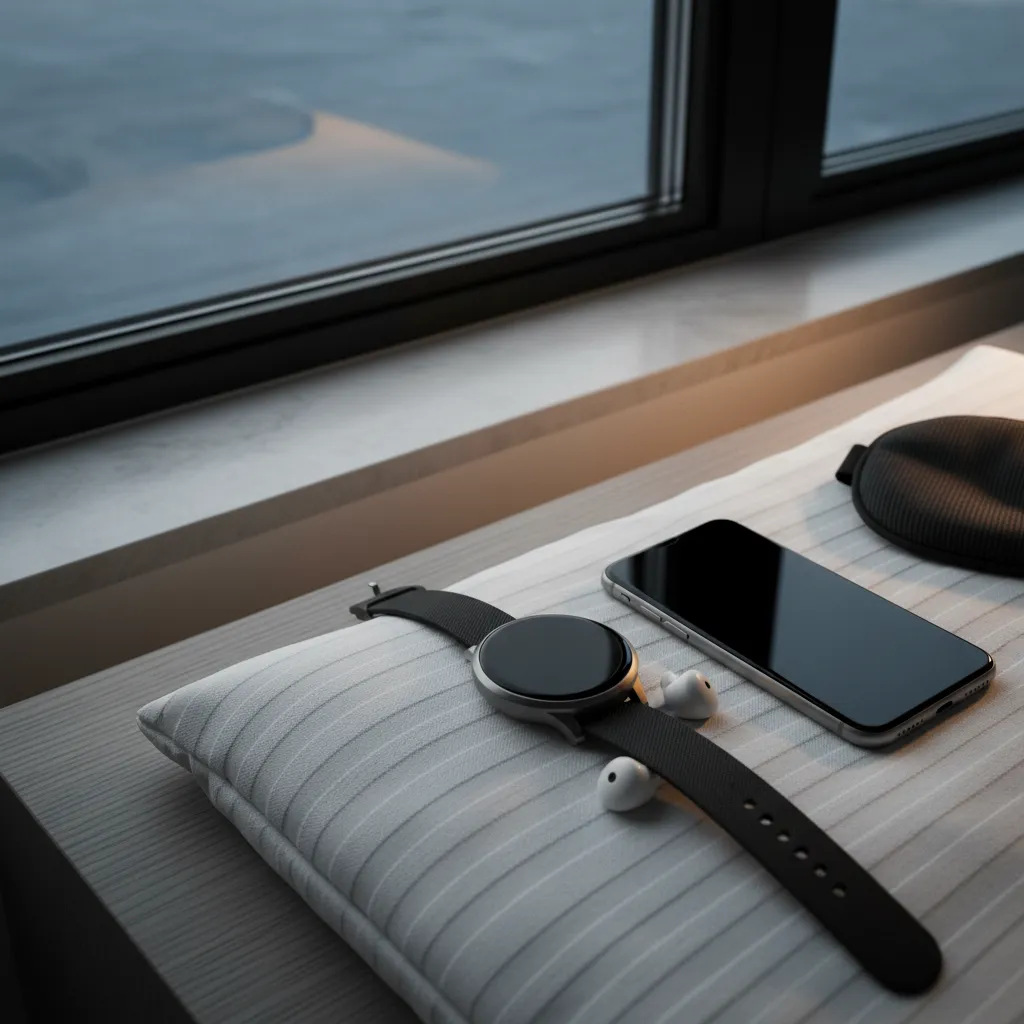
If you use a sleep tracker — Oura, Whoop, Apple Watch, Garmin — start logging your sleep consistency alongside your learning performance. You'll notice patterns within two weeks. Days after poor sleep show measurably worse recall. The data makes the invisible tangible.
5. Guard Your Sleep Environment
Cool room. Dark room. No screens in the final thirty minutes. This isn't generic sleep hygiene advice repackaged — it directly impacts slow oscillation amplitude. Bigger, cleaner slow oscillations mean more nesting opportunities for spindles. The physical environment literally shapes the electrical architecture of your memory consolidation.
The Comparison That Changes Everything
Let's zoom out and hold two paradigms side by side.
The Brute-Force Paradigm: Study more. Study harder. Stack apps. Fill every free minute with input. Measure progress by hours logged.
The Sleep-Integrated Paradigm: Study strategically. Time sessions to circadian biology. Prioritize sleep as a non-negotiable pillar of the learning process. Measure progress by retention quality, not input volume.
The brute-force approach feels productive. It generates satisfying metrics — streaks maintained, cards reviewed, minutes logged. But it ignores the consolidation bottleneck. You can pour water into a glass forever; if the glass has no bottom, it never fills.
The sleep-integrated approach feels counterintuitive. Study less in the evening? Go to bed instead of cramming? Trust that your brain will do the work while you're unconscious?
Yes. Exactly that.
The neuroscience is no longer ambiguous. Memory consolidation for language is not a passive side effect of rest. It is an active, architecturally complex, electrically orchestrated process that your brain performs with extraordinary precision — if you let it.
What This Means for the Future of Language Learning
We're standing at a convergence. Wearable biometric data is ubiquitous. AI scheduling algorithms are sophisticated. And the neuroscience of sleep and language learning has reached a clarity that demands integration.
The next generation of language learning tools won't just know what to teach you. They'll know when your brain is best prepared to receive it, consolidate it, and integrate it into fluency. They'll treat your sleep architecture as training data — as fundamental as your proficiency level or your native language.
At LingoTalk, we believe this convergence represents the most exciting shift in language education since spaced repetition itself. We're exploring how circadian-aware design can reshape the learning experience — not by adding complexity, but by removing friction between how you study and how your biology actually works.
The Takeaway You Can Use Tonight
You don't need a new app. You don't need a new method. You don't need more willpower.
You need more sleep. Better-timed sleep. Sleep treated not as the absence of study, but as the deepest form of it — the phase where spindles lock into oscillations, where hippocampal traces migrate to the cortex, where the grammar you struggled with at 8 PM becomes the grammar you feel at 8 AM.
Tonight, close the app an hour earlier. Dim the lights. Let your brain do what three billion years of evolution designed it to do.
Then wake up — and notice what you remember.
Ready to speak a new language with confidence?