
The Science-Backed "Speak First" Method: Why Starting Conversations Before You're Ready Accelerates Fluency
Here's a confession that might sting a little: that grammar textbook you've been grinding through? Those flashcard decks with 3,000 words? They're not useless—but they might be the reason you still freeze up the moment someone actually talks to you in your target language.
I know. I've been there. Staring at a barista in Lisbon, mentally conjugating querer in the present tense while she waited, eyebrows raised, for me to just… order a coffee. I had studied Portuguese for four months. I couldn't order a coffee.
Turns out, the science has finally caught up to what polyglots and street-smart travelers have known forever: if you want to speak a language, you need to start speaking it. Like, immediately. Before you're ready. Especially before you're ready.
The 2026 Research That Flipped Language Learning on Its Head
Earlier this year, a landmark study out of the Max Planck Institute for Psycholinguistics—published in Cognition (February 2026)—tracked 1,200 adult language learners across six languages over 12 months. The researchers split participants into two groups:
- Group A followed a traditional path: grammar instruction first, vocabulary building, reading comprehension, and then—after about 8-12 weeks—conversation practice.
- Group B started having real conversations in their target language within the first seven days. Messy, broken, error-filled conversations. They still studied grammar and vocabulary, but speaking came first.
The results weren't subtle. Group B reached conversational fluency (defined as the ability to sustain a 10-minute unscripted conversation on everyday topics) 3.1 times faster than Group A. Not 10% faster. Not twice as fast. Three times.
But here's the part that really got me: Group B also reported higher motivation, lower anxiety, and greater enjoyment of the learning process. They made more errors early on—obviously—but their error rates converged with Group A's by month six. Same accuracy, wildly different timeline.
Let that sink in for a second.
Why Your Brain Learns Faster When You Speak First
Okay, so the data is compelling. But why does starting to speak before you're ready actually work? It feels counterintuitive. Like showing up to a piano recital before you've learned the scales.
Except language isn't piano. Language is more like swimming.
You can read every book about swimming technique. You can memorize the physics of buoyancy. You can watch Olympic footage on loop. But the moment you hit the water, your body has to figure it out in real time. And that real-time figuring out? That's where the learning actually happens.
Procedural Memory vs. Declarative Memory
Here's the neuroscience bit (I'll keep it short, promise). When you study grammar rules and vocabulary lists, you're engaging declarative memory—the same system you use to remember historical dates or your dentist's phone number. It's conscious, effortful, slow.
But fluent speech doesn't run on declarative memory. It runs on procedural memory—the same system that handles riding a bike, typing on a keyboard, or catching a ball. It's automatic, fast, and subconscious.
The only way to build procedural memory for language? Using the language. Speaking it. Fumbling through it. Getting it wrong and self-correcting in real time.
Grammar study alone keeps you trapped in declarative mode. You know the rules, but you can't use them at conversational speed. It's like knowing the theory of bicycle balance but never actually pedaling.
The "Desirable Difficulty" Effect
There's another mechanism at play, and it's beautifully named: desirable difficulty. Cognitive psychologist Robert Bjork coined the term decades ago, and the 2026 study explicitly references it.
When you struggle to produce a sentence—reaching for a word you half-remember, improvising around a grammar structure you haven't fully learned—your brain works harder to retrieve and assemble language in real time. That struggle feels uncomfortable. It feels like failure.
It's not failure. It's your brain building neural pathways at an accelerated rate.
The learners in Group B weren't succeeding despite their early errors. They were succeeding because of them. Every mistake was a micro-lesson their brains encoded more deeply than any textbook explanation ever could.
The Real Obstacle Isn't Knowledge—It's Fear
Let's be honest about something. Most people don't avoid speaking early because they've made a rational decision to master grammar first. They avoid it because speaking a language badly in front of another human being is terrifying.
I get it. Deeply.
There's this specific flavor of vulnerability that comes with being an adult who sounds like a toddler. You're smart. You're competent. You have a whole personality in your native language—you're funny, nuanced, sharp. And then you open your mouth in Spanish and suddenly you can't express anything more complex than "I want water" and "Where is the bathroom?"
It's ego death. Tiny, repeated ego death.
And that fear creates a vicious cycle: you don't speak because you're not ready, but you'll never feel ready because you're not speaking. Months pass. Years, sometimes. You accumulate knowledge but never fluency.
The 2026 study actually measured this. Learners in Group A (the traditional path) showed increasing speaking anxiety over time, peaking right around the point when they were "supposed" to start conversations. Group B's anxiety spiked in week one—and then dropped steadily from there.
The fear doesn't go away by preparing more. It goes away by doing the thing.

So How Do You Actually Start Speaking in Week One?
This is where things get practical. Because "just start speaking" is great advice in theory, but if you're learning Korean in rural Kansas, you can't exactly wander into a Korean conversation circle on Tuesday night.
Here are the approaches that actually work, ranked by accessibility:
1. AI Conversation Partners (The Game Changer)
This is honestly where the speak first language learning method becomes realistic for everyone, not just people living in their target country.
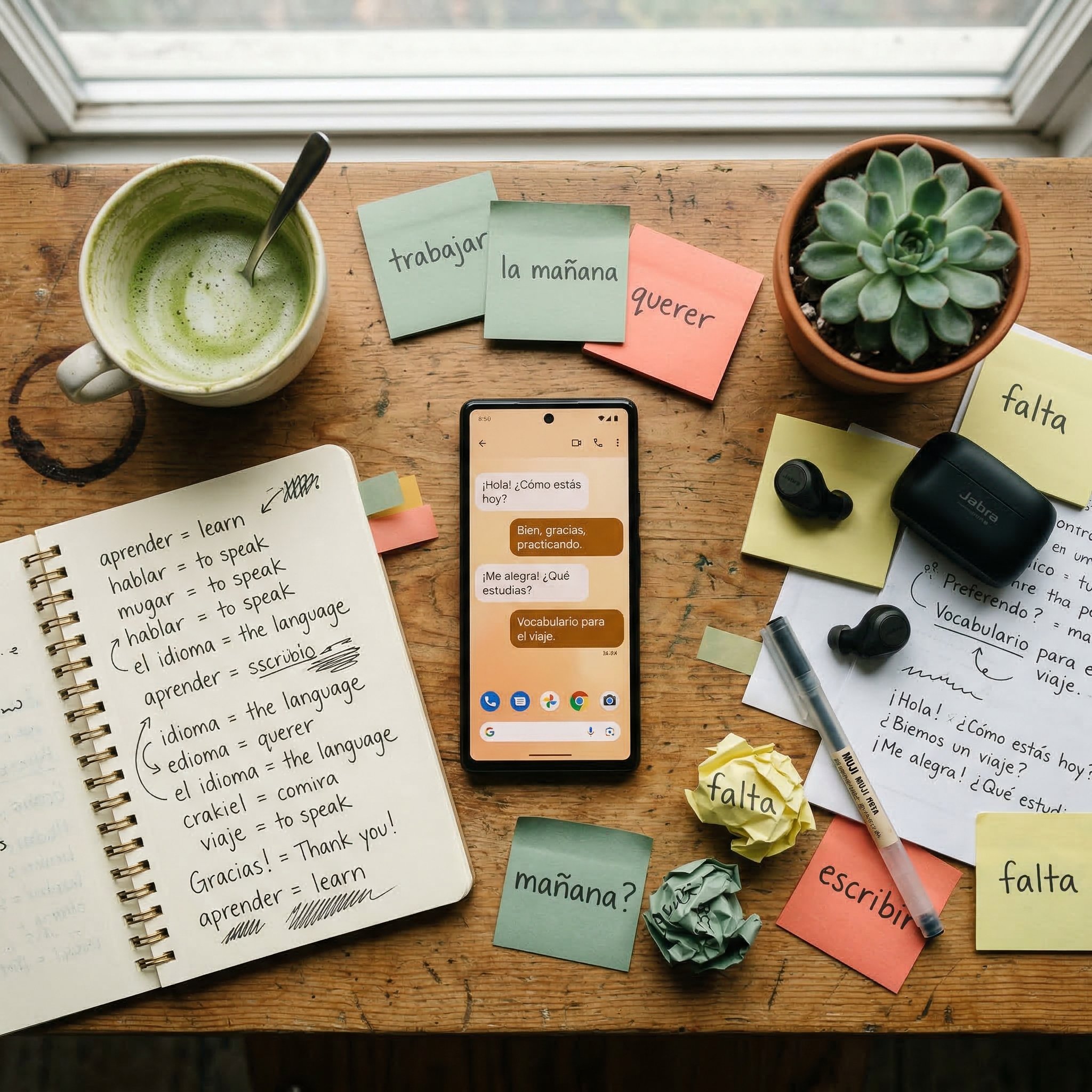
Tools like LingoTalk's AI conversation partner let you have real, unscripted conversations in your target language from day one. No scheduling. No awkwardness. No judgment when you butcher a subjunctive or accidentally tell someone their grandmother is a potato (true story, my Italian phase was rough).
What makes this different from repeating phrases into an app? LingoTalk actually responds to what you say. It adapts. It's a conversation, not a drill. You're building that procedural memory in real time, with the safety net of knowing your conversation partner will never laugh at you, lose patience, or switch to English because it's easier.
For the speak-first method specifically, this is massive. The biggest barrier to speaking early is finding a zero-judgment practice space. LingoTalk is that space.
2. Language Exchange Partners
Great in theory, genuinely wonderful when it works. Apps like Tandem or HelloTalk connect you with native speakers who want to learn your language. The catch? Scheduling is a nightmare, there's a social dynamic to navigate, and—let's be real—the power imbalance when one person is advanced and the other is a beginner can make things awkward fast.
Still worth doing. Just not as your only speaking practice.
3. Self-Talk (Seriously)
Narrate your day in your target language. Describe what you see on your commute. Argue with yourself about what to have for dinner. It sounds unhinged. It works. You're activating production pathways without any social pressure at all.
Combine this with AI conversation practice and you've got a speak-first system that doesn't require moving to another country or finding a patient human being willing to endure your early attempts.
The "Good Enough" Threshold: How Much Grammar Do You Actually Need?
I'm not saying burn your textbooks. (Well, maybe that one. You know the one.) The speak-first method isn't anti-grammar. It's anti-grammar-first.
Here's a practical framework the researchers suggested:
- Days 1-3: Learn 30-50 survival phrases. Greetings, basic questions, "I don't understand," "Can you repeat that?" Numbers 1-10. That's it.
- Days 4-7: Start having conversations. Use what you have. Point at things. Mime. Use your 50 phrases and see how far they take you.
- Weeks 2-8: Layer in grammar as you need it. When you notice you keep wanting to talk about the past but can't, that's when you learn past tense. The motivation is intrinsic because the need is real.
This is fluency building technique at its most effective: grammar becomes a tool you reach for, not a prerequisite you suffer through.
What This Looks Like in Practice (A Real Example)
Let me paint you a picture. Say you're learning French.
Week 1, traditional method: You learn articles (le, la, les), subject pronouns, present tense conjugation of être and avoir, and maybe 100 vocabulary words organized by theme. You can write "The cat is on the table." You cannot have a conversation.
Week 1, speak-first method: You learn "Bonjour," "Je m'appelle…," "Comment ça va?," "Je ne comprends pas," "Répétez, s'il vous plaît," and maybe 30 other phrases. Then you open LingoTalk and have a halting, messy, glorious five-minute conversation about the weather. You get corrected gently. You learn that "il fait beau" means it's nice out—not from a vocab list, but because you needed it in the moment.
Guess which version sticks?
The Courage to Be Bad at Something
Here's what I really want to leave you with, and it goes beyond language learning.
We live in a culture that worships competence. We curate our lives to look polished. We don't post the ugly drafts, the failed attempts, the moments where we sound ridiculous.
But fluency—in any language, in any skill—lives on the other side of being willing to be bad at something. Publicly. Repeatedly. With grace and maybe a little humor.
The speak-first method isn't just a learning hack. It's a mindset shift. It says: I don't need to be perfect to participate. I don't need to be ready to begin.
So here's my challenge to you. Whatever language you're learning—or thinking about learning—speak it today. Out loud. To LingoTalk's AI, to your cat, to your bathroom mirror. Say something wrong. Say something weird. Say anything.
Because three months from now, you won't remember the grammar rule you memorized on a Tuesday. But you'll absolutely remember the first time you stumbled through a real conversation and realized—holy shit—they understood me.
That's the moment fluency begins. And it begins before you're ready.
Ready to speak a new language with confidence?