
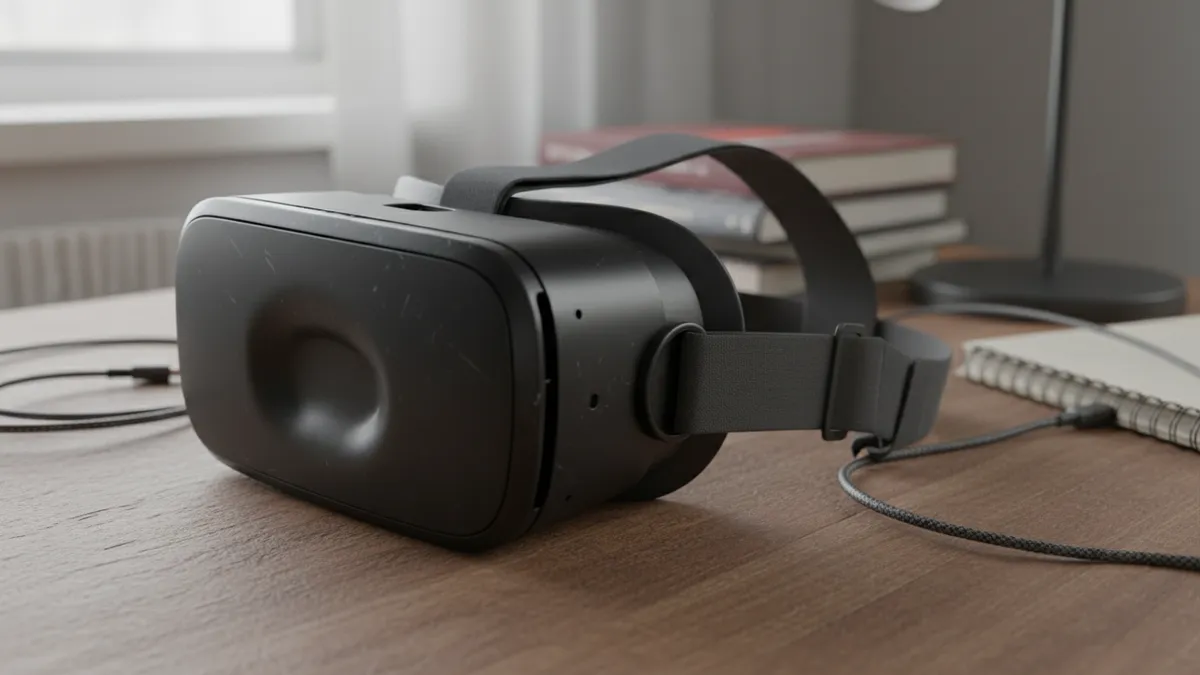
Put On a Headset and Get Fluent: How VR Worlds Like VRChat and Meta's Spatial Lingo Are Becoming the Most Immersive AI Language Practice Environments of 2026
Flashcards don't make you fluent. Neither do grammar drills at midnight. Repeating "Where is the library?" into a phone screen? That's not going to save you at a bustling tapas bar in Seville. Watching foreign-language Netflix with subtitles on? Closer, but you're still on the couch, and the couch doesn't talk back.
What actually works is immersion — being thrown into a world where the target language is the air you breathe, where making mistakes carries just enough social weight to sharpen your focus, and where you forget you're "studying" because you're too busy living. The problem, of course, is that moving to Tokyo for a year is expensive. Moving to São Paulo is complicated. Moving anywhere is, for most people, a logistical fantasy.
So what if the world came to you instead? That's the promise of VR language learning in 2026, and for the first time, the technology is actually keeping the promise.
The Living Room That Became a Foreign Country
Virtual reality language immersion has gone from novelty demo to genuine pedagogical force in the span of about eighteen months. The catalyst wasn't a single app — it was a collision of forces. Meta's open-source Spatial Lingo mixed-reality app launched in late 2025 and immediately blew the doors off what people expected from headset-based education. VRChat — that chaotic, beautiful, occasionally baffling social platform — quietly evolved into one of the largest multilingual conversation exchanges on the planet. And purpose-built platforms like IMMERSE VR kept refining structured lesson environments that feel less like a classroom and more like stepping into a parallel life.
The result? People are learning languages in VR in 2026 not because it's trendy, but because it works like a cheat code for speaking confidence.
Why Your Brain Believes the Simulation
Here's the thing about language anxiety — it lives in your body. Sweaty palms. A tightening throat. That moment where you know the word but your mouth refuses to produce it because seven people are staring at you in a café and you've already said "uhh" three times. Traditional apps can't touch that problem. They operate in a cognitive sandbox where the stakes are zero, which means the confidence gains are tissue-thin.
VR sits in a fascinating middle zone. Early research from the University of Central Florida and a 2025 study published in Language Learning & Technology found that learners practicing in VR environments reported up to 40% lower speaking anxiety compared to in-person conversation groups — but critically, they still felt genuine social presence. Your brain registers the avatar across from you as a real conversational partner. The stakes feel real enough to trigger growth, but safe enough to let you stumble without shame.
That's the sweet spot. Like a flight simulator for your mouth.
VRChat: The Accidental Language School
Nobody designed VRChat to be an educational tool. It was built for socializing, creativity, and — let's be honest — a healthy dose of absurdity. But something beautiful happened when millions of people from different countries started hanging out in the same virtual rooms: they taught each other their languages. Voluntarily. For fun.
VRChat language practice has become its own subculture. Dedicated worlds like "Language Exchange Lounge," "Japanese Practice Shrine," and "Polyglot Plaza" pull in hundreds of concurrent users every evening. The format is disarmingly simple — you show up, you talk, you gesture wildly with your virtual hands when vocabulary fails you. Native speakers volunteer as conversation partners. Beginners cluster together and fumble through basic phrases with the kind of giddy energy you usually only see in study-abroad cohorts.
What makes it sticky is the social architecture. You're not matched with a tutor and handed a lesson plan. You're making friends. You're joining a community. You return because you genuinely want to talk to that Korean student who's obsessed with Brazilian funk music, or the retired French teacher who hangs out in the café world every Thursday and corrects your subjunctive with grandfatherly patience.
People don't accidentally become trilingual through discipline alone. They do it through relationships. VRChat, improbably, provides the relationships.
Meta Spatial Lingo: Structured Immersion Goes Open-Source
If VRChat is the chaotic street market of VR language immersion, Meta Spatial Lingo is the well-designed boutique next door. Launched as an open-source mixed-reality framework, Spatial Lingo lets learners interact with AI-driven characters and real human partners inside context-rich environments — a simulated pharmacy in Berlin where you need to ask for cold medicine in German, a train station in Osaka where the announcements are in Japanese and you have sixty seconds to find your platform.
The genius is in the contextual scaffolding. Vocabulary isn't presented in a list; it's embedded in the environment. Need to learn food vocabulary? You're standing in a virtual mercado in Mexico City, picking up limes, asking the AI vendor about prices, haggling a little. The spatial memory effect is real — studies on embodied cognition suggest that physically interacting with objects (even virtual ones) while learning associated words creates stronger memory traces than passive review.
Because it's open-source, developers worldwide have been building custom Spatial Lingo environments at a staggering pace. There's a Mandarin dim sum restaurant. A Portuguese surf shop. An Arabic-language bookstore in a recreation of old Cairo. The ecosystem is expanding faster than any single company could manage, which is exactly the point.
IMMERSE VR and the Structured Path
For learners who want more guidance — actual lesson progression, grammar integration, proficiency tracking — platforms like IMMERSE VR fill the gap beautifully. Think of it as the difference between learning to cook by experimenting in your kitchen versus enrolling in a cooking course that also happens to take place inside a Michelin-star restaurant. Both have value. Different learners need different structures.
IMMERSE VR's approach layers live instruction from certified teachers onto immersive scenarios. You're not just chatting; you're completing communicative tasks — ordering a meal, negotiating a hotel room change, explaining symptoms to a doctor — with real-time feedback on pronunciation, grammar, and pragmatic appropriateness. It's structured virtual reality language immersion with measurable outcomes, and corporate language training programs have started adopting it aggressively.
How to Set Up a VR Language Practice Routine on a Budget
Now, the practical question. You don't need a $1,500 headset and a dedicated VR room to start learning languages in VR in 2026. Not even close.
The Hardware
A Meta Quest 3S — currently hovering around $250 — handles everything mentioned in this article. VRChat runs natively on it. Spatial Lingo was literally designed for the Quest ecosystem. IMMERSE VR supports it fully. That's your entry point. Done.
The Weekly Routine
Here's a framework that balances structure with the glorious chaos of social VR:
- Monday & Wednesday (30 min): Spatial Lingo scenario practice. Pick one real-world context per week — a pharmacy, a train station, a grocery store. Repeat the scenario until navigation feels natural.
- Tuesday & Thursday (30 min): VRChat language exchange worlds. Show up. Talk. Make mistakes. Make friends. This is your unstructured immersion time — the equivalent of wandering a foreign city and striking up conversations.
- Saturday (45 min): IMMERSE VR or a similar structured lesson. Use this to address specific weaknesses you noticed during the week.
- Daily (10 min): Review vocabulary and phrases from your VR sessions using a companion app. This is where tools like LingoTalk slot in perfectly — reinforcing the words and expressions you actually encountered in context, not random textbook lists.
That's roughly three hours a week. The cost of a used Quest headset and free or low-cost apps. The immersion quality of a study-abroad semester. Not a bad trade.
The Anxiety Gap Is the Real Story
We keep circling back to anxiety because it's the elephant in every language classroom. Most adult learners don't fail because they lack intelligence or motivation. They fail because speaking feels mortifying, so they avoid it, so they never get better, so speaking continues to feel mortifying. A vicious cycle as elegant as it is destructive.
VR breaks the cycle not by removing the social element but by softening it — like turning down the volume on your self-consciousness just enough to let words come out. You're still talking to real people. You're still navigating real communicative challenges. But the avatar layer, the novelty of the environment, and the implicit understanding that everyone in a VR language world is there to practice — it all conspires to lower the drawbridge.
Researchers at the University of Barcelona found that learners who spent eight weeks in VR conversation practice showed speaking confidence gains equivalent to what traditional learners achieved in roughly five months. Not because VR is magic. Because VR gets people to actually open their mouths.
Not a Gimmick Anymore
Two years ago, suggesting someone learn a language in VR would've earned you a polite smile and a subject change. Fair enough — the tech wasn't there, the content wasn't there, and strapping a screen to your face to conjugate verbs felt like solving the wrong problem with the most expensive tool available.
That era is over. The convergence of affordable hardware, open-source immersion platforms like Meta Spatial Lingo, thriving social ecosystems like VRChat, structured programs like IMMERSE VR, and a growing body of research confirming real learning outcomes — it all adds up to something that deserves to be taken seriously.
VR language immersion in 2026 is the closest thing to moving abroad without leaving your living room. It's not perfect. It can't replicate the full sensory overwhelm of actually being in a foreign country. But it captures the thing that matters most: the need to communicate with another human being, right now, in real time, with no subtitle track to save you.
That's where fluency lives. Not in an app. Not in a textbook. In the beautiful, nerve-wracking, exhilarating moment when you open your mouth and try.
Put on the headset. Step into the world. Your living room is about to get a lot bigger.
Ready to speak a new language with confidence?